
That Muddy Creek
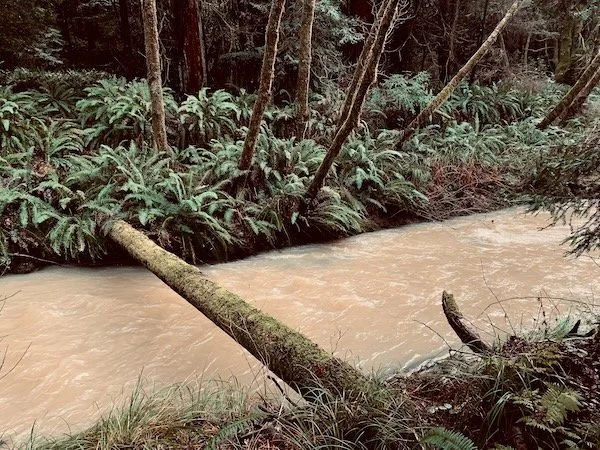
From the fall through the spring, Pudding Creek most often is a pretty slate color. I'm not really sure why this is—whether it is because of sediment, the temperature (very cold!), or the reflection from the lush ferns and emerald green redwood branches gracefully sweeping down. It is easy to see the fish, and it's not too hard to cross over in a pair of rubber boots.
However, with all of this rain the creek is transformed into a roaring, muddy, fast-flowing torrent. There is no way to safely cross, and anything could be below the surface. The color turns a chocolate brown from the runoff, and I wonder if this is why the creek was named "Pudding"—as in Chocolate Pudding!
Do you know the word "papanca?" This is a Buddhist (Pali is the language) word meaning mental proliferation or the spreading out of thoughts. Even if you don't know the word, I am sure that you know the experience. Like when the mind weaves tale after tale about a situation and somehow can't seem to put the thoughts down. We end up not seeing clearly what is or has happened because the mind is busy with the storyline. It can be a tale of outrage, anger, grief, or even about something positive happening (like a pot of gold happening at the end of the rainbow). Ultimately, papanca actually takes us out of the present, which is where our power and courage live.
Papanca (pronounced papancha) is a lot like that muddy creek. It isn't clear what is going on because there is so much sediment and roar. It's easy enough to wait until the creek flows clear again, but a lot harder to figure out what to do when your own mind is flooded with mental preoccupations. And it is also all around us. We are saturated in the collective fear and outrage that permeates the news, social media, and our communities.
This is what yoga, mindfulness, and other regulating practices are for. It is easier to clear the mind of its papanca by working with the body. And I don't mean just by doing fancy yoga poses. Anything that allows you to rest back into the present moment through the body will do. We are at a critical juncture, and it is very important to find ways to calm the heart and mind.
The revered Buddhist teacher Thich Nhat Hanh said, “When the crowded Vietnamese refugee boats met with storms or pirates, if everyone panicked all would be lost. But if even one person on the boat remained calm and centered, it was enough. It showed the way for everyone to survive.”
This is the time for your yoga practice, mindfulness practice, nature practice, and any other practices you have to restore your equilibrium. It does no one any good when you (or me!) are lost in stories—papanca—of impending calamity, doom, and anger.
All of my offerings, both online and in person, are filled with methods that recenter. Join me. It is imperative that we do this again and again (meaning this isn't a one-and-done kind of situation!).
Of course, it starts with practice but does not end there. Our practice supports us to meet both our personal and collective challenges.
Then we'll rise up with strength, energy, and hope to tackle the obstacles ahead.